Here is a question most advertisers could not answer until this month: when Google spends your ad budget, who decides which channels get it first?
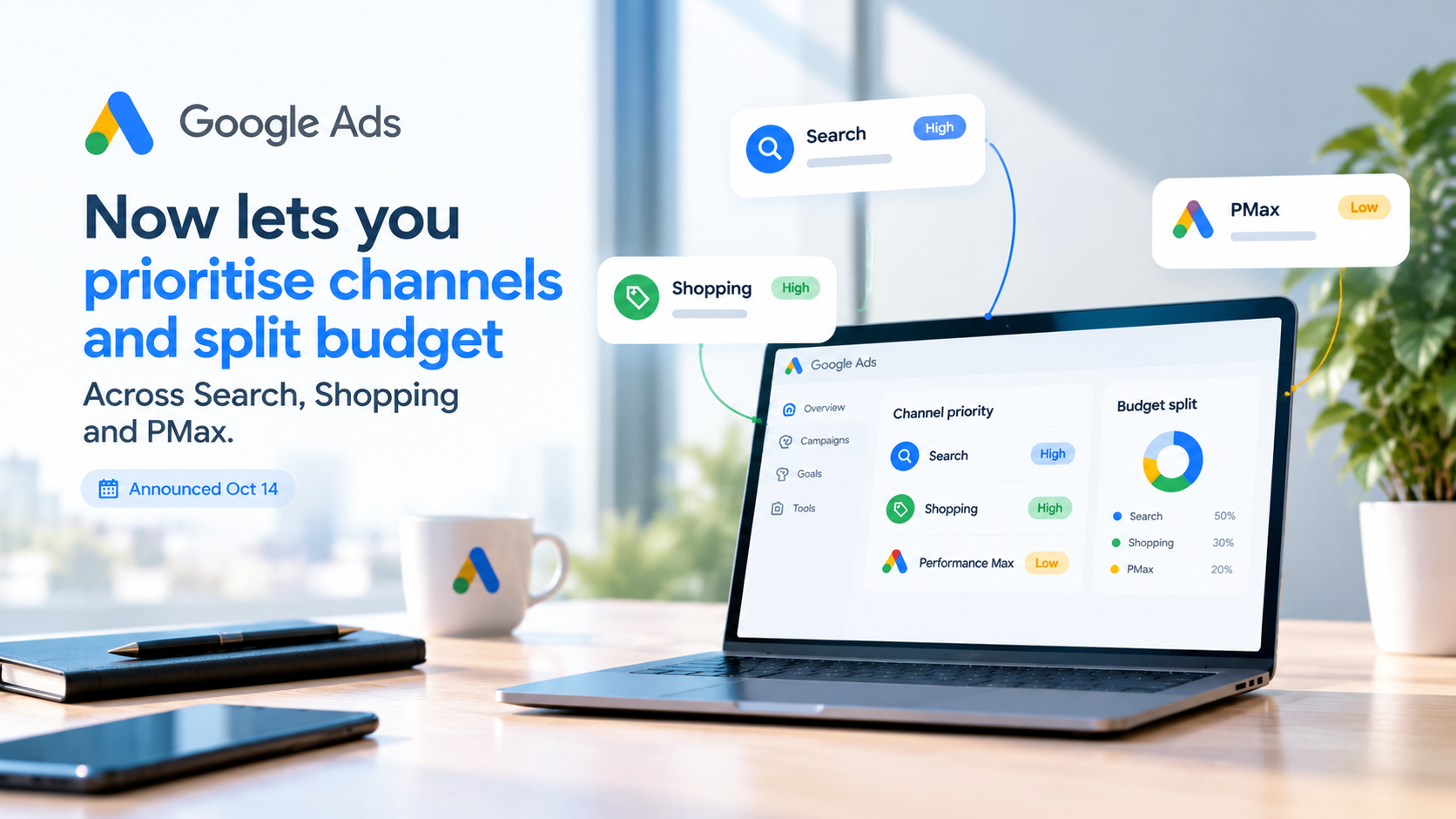
Until now, this was largely handled by Google’s AI. Google has introduced two optional controls that give advertisers more influence over budget distribution. Google Ads channel prioritization lets advertisers mark eligible channels as High or Low priority, allowing Google to priorities spending on High-priority channels first. Budget allocation adds another layer of control by setting a target percentage of the average daily budget for eligible Low-priority channels.
This Google Ads update from October 2026 might sound niche. It is not. If you pay for Google Ads, work with a team offering Google Ads management services, or simply want to know where ad money goes, it changes what you can ask for.
What Is Google Ads Channel Prioritisation?
A “channel” is a place where your ads can run: Google Search, Search partners (third-party sites that show Google search ads), or the Google Display Network (websites and apps that show image and video ads). Until now, the choice was often all or nothing. Either Google could use a channel, or you switched it off.
Channel prioritization adds a middle option. Think of a household budget: rent and groceries get paid first, and treats get whatever is left.
-
- High priority channels are funded first, within your Target CPA or Target ROAS if you use one. Those are bidding goals for a set cost per conversion or a set return on ad spend. Every channel starts as High.
-
- Low priority channels get what remains, and you can add an optional cap.
-
- Opted out, or a 0% allocation means no spend at all.
The AI stays switched on. Google’s systems still choose the placements inside each channel. For background, see how AI-driven campaigns are changing optimisation.
How Does Google Ads Budget Allocation Work?
For a Low-priority channel, you can add a daily budget allocation percentage. Google calculates it from the campaign’s average daily budget, not from what is actually spent.
Hypothetical example: a Search campaign has an average daily budget of 200 in the account currency. Search partners are set to Low priority with a 10% allocation. Google then aims to keep partner spend at or below 20 a day.
It is best-effort, so spend on a channel may occasionally exceed the percentage. It resets daily, and shared budgets apply it to the budget as a whole. Google explains the details in its Help Center page on channel prioritizationand budget allocation.
Can You Set Search Partners to Low Priority in Google Ads?
Yes. In Search, Shopping and Performance Max campaigns, Search partners can be set to Low priority. Google then funds them after the High-priority channels, and you can add an optional cap. This gives advertisers who switched Search partners off in the past a way to test them with limits.
Can You Cap Display Network Spend in Google Ads?
In Search and Performance Max campaigns, yes. Set the Display Network to Low priority and add an allocation percentage. It is a best-effort limit, not a hard stop.
Demand Gen works differently. It supports channel prioritization for the Display Network, but budget allocation is not supported, so there is no percentage cap there.
Can You Control YouTube Spend in Performance Max?
Not separately. In Performance Max, Google groups Search, YouTube, Maps, Gmail and Discover as “Google channels”, so YouTube cannot be ranked above or below Search. Search partners and the Display Network can each have their own priority. Google’s Performance Max guide explains the grouping.
Does Demand Gen Support Budget Allocation?
No. Demand Gen supports channel prioritization for Google channels and the Display Network, but not budget allocation.
What Changes for Display Expansion in February 2027?
From February 2027, Google says Search campaigns with Display Expansion will transition automatically to channel prioritization. The current spend allocation setup will go away, and channel spending may shift.
To keep the existing configuration, Google suggests setting the Display Network to Low priority with a 50% allocation. Google also says the Display Network will no longer serve on Search campaigns that use Target Impression Share. The details are in Google’s guide to Display Expansion on Search campaigns.
Why Can’t I See Channel Prioritisation in My Google Ads Account?
Most likely because the roll out is gradual. Google says access began appearing from 15 October, and availability varies by campaign type and timing. One more thing to check: priorities cannot be set from a manager account, so open the individual account instead. Google’s Help Center also says API and Editor support is coming soon.
Why Is Google Doing This?
Google says marketers want more transparency and choice over where their budgets go. It describes the controls as more flexible than all-or-nothing opt-outs, and says advertisers who avoided Search partners or Display can now test them with clearer limits.
The Upside, Realistically
These are potential benefits, not guarantees:
-
- More control over which channels are funded first
-
- Easier testing of channels you used to avoid, with a spending ceiling
-
- Better alignment between spend and business goals
-
- Flexibility for campaigns that run into their budget limit
Google does not promise lower costs, more conversions or a higher return on ad spend, and neither do we.
What to Keep in Mind
-
- Caps are not hard limits. Google calls them best-effort.
-
- Some campaigns may see little change. If a Target CPA or Target ROAS campaign is not limited by budget, Google says priority generally does not change spend. Allocation percentages still apply.
-
- Performance Max still looks at the whole picture. Google says it is designed to maximize performance across all channels, not any single one, as its channel performance tips explain.
How AI.Que Media Can Help
A new control is only useful if you know whether it applies to your account. That is where an experienced team can save time:
-
- Checking whether the controls have reached your account yet
-
- Reviewing conversion tracking, so channels are judged on qualified leads, not clicks alone
-
- Reading results by channel before deciding whether to change anything
-
- Planning for the February 2027 change on Search campaigns
You can see how we work in our case studies, explore our performance marketing solutions, or see how conversion rate optimisation helps turn clicks into enquiries.
Google Ads channel prioritization is optional, best-effort and still rolling out. The direction is clear: more say for advertisers, with the AI still doing the heavy lifting.
Curious what this could mean for your campaigns? Get in touch with AI.Que Media to talk through your Google Ads setup.
Frequently Asked Questions
Not Sure If Your Digital Marketing
Is Actually Working For You?
We Will Give You An Honest Assessment Of Where You Stand And What The Fastest Path To Growth Looks Like.
Book Your Free Consultation →No Commitment. No Sales Pitch. Just A Straight Conversation About Your Growth.