Digital advertising has quietly changed jobs. A decade ago, “optimizing” a campaign meant an advertiser hand-picking interests, layering exclusions, testing bids manually, and adjusting placements one at a time. Today, that work is increasingly handled by machine learning systems running inside Meta and Google’s ad platforms systems that decide, auction by auction, who sees which ad, at what bid, and on which placement.
This shift is what people mean when they talk about AI in ad targeting. It’s not a single feature or campaign type it’s a structural change in how AI-powered advertising decides who gets reached, and it’s reshaping what “optimization” actually requires from any digital marketing agency working in this space.
At AI.Que Media, a full-service online marketing company and digital marketing agency, we work with this shift daily across performance marketing engagements. As a digital agency trusted by clients across multiple regions, we wanted to lay out plainly what’s changed, what hasn’t, and what still needs a human in the loop.
From Manual to AI-Driven
Traditional optimization meant manually defining audiences, setting bids, and adjusting them by hand based on performance; every change was a discrete, human-initiated action.
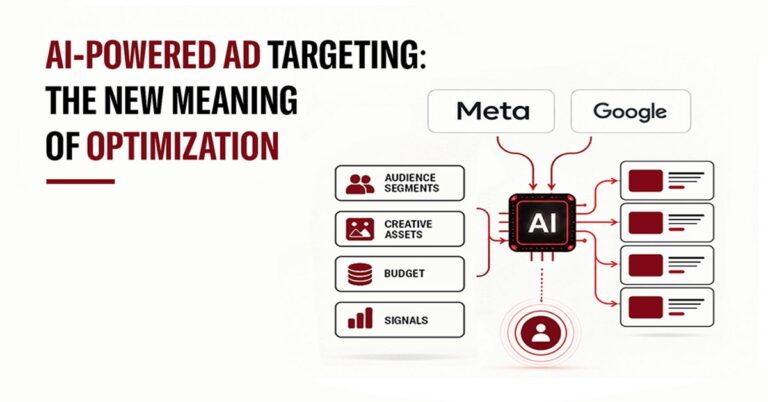
AI-driven optimization flips this. Platforms now observe real-time signals engagement, conversion likelihood, auction dynamics and adjust targeting, bidding, and delivery continuously. Your job shifts from setting narrow rules to feeding the system good inputs: quality creative, clean data, and clear signals about who converts.
Targeting inputs aren’t obsolete; they’re suggestions now, weighed alongside the algorithm’s own data rather than treated as hard filters.
Meta vs. Google AI Campaigns
A side-by-side comparison of AI-driven advertising tools
| Meta (Advantage+) | Google (PMax / Smart Bidding) | |
| Platform focus | Facebook, Instagram, Messenger, Audience Network | Search, Shopping, Display, YouTube, Gmail, Discover, Maps |
| Audience discovery | Audience suggestions guide delivery; hard controls (age, location, exclusions) still respected | Audience signals (Customer Match, remarketing, custom segments) guide Performance Max; broad match relies on query-intent matching |
| Creative optimization | Creative variety and format testing are core delivery inputs (Advantage+ Creative) | RSAs test headline/description combinations; PMax mixes assets across channels automatically |
| Bidding | Advantage Campaign Budget shifts spend across ad sets automatically | Smart Bidding (Target CPA/ROAS, Maximize Conversions/Value) sets bids per auction |
| Conversion signals | Pixel/Conversions API events, engagement, on-platform behavior | Conversion actions, enhanced conversions, offline conversion import |
| Marketer control | Audience controls, budget caps, creative inputs, exclusions | Asset groups, search themes, negative keywords, audience signals, brand exclusions |
Neither platform is categorically “better” they serve different inventory and different stages of the funnel, and most full-funnel strategies use both.
What Signals AI Actually Evaluates
Neither Meta nor Google publish the full mechanics of its ranking or delivery algorithms, and AI.Que Media doesn’t claim insight into confidential model internals. Publicly documented and broadly observable information reveals the signals category these systems draw on.
- User intent signals : search terms, browsing behavior, and on-platform engagement patterns
- Conversion data : what the advertiser has told the platform counts as a valuable action, and how often it happens
- Creative performance : how different headlines, images, or videos perform with different audience segments
- Audience behavior : patterns among people who have already converted, used to find others with similar likelihood
The practical implication is straightforward: the system can only optimize toward signals it actually receives. This is why data quality has become as important as creative quality.
Why Tracking, Data Quality, and Clear Objectives Matter More Now
In manual campaigns, a marketer could partially compensate for messy data with hands-on judgment. In automated campaigns, the algorithm is the judgment and it’s only as good as what it’s fed.
- Ensure conversion tracking is accurate, because Smart Bidding and Advantage bid toward whatever is marked as a conversion. Broken or duplicated tracking doesn’t just misreport results it actively misdirects spend.
- High-quality data (clean feeds, enhanced conversions, first-party customer lists) gives the algorithm more to learn from, especially as third-party signals become less reliable.
- Creative testing still matters arguably more than before because in creative-led delivery systems, the ad itself has become one of the strongest targeting signals available.
- Clear campaign objectives prevent the system from optimizing toward the wrong outcome; a campaign set to “maximize clicks” will do exactly that, even if clicks aren’t the business goal.
This is also where SEO services and CRO intersect with paid media: a page that converts well and loads fast doesn’t just help organic rankings, it feeds automated bidding systems better signal, which improves paid performance too.
The Marketer’s Role Is Shifting, Not Disappearing
As platforms absorb more manual, mechanical work, the marketer’s value moves upstream into strategy, creative direction, data hygiene, and quality assurance.
That looks like:
- Deciding what to optimize toward (which conversion event actually matters to the business)
- Supplying a steady volume of genuinely different creative concepts, not variations on one idea
- Auditing tracking setups regularly, rather than assuming they still work
- Reviewing search term and placement reports to catch waste automation won’t flag on its own
- Making judgment calls automation can’t brand tone, seasonal context, competitive positioning
This is the core of AI.Que Media’s approach, AI-Augmented, Human-Led: let automation handle bidding math and delivery mechanics at a scale no person could manage manually, while strategy, creative direction, and oversight stay firmly with people who understand the business.
Common Challenges With AI-Driven Campaigns
Automation removes some manual work, but it introduces its own failure modes:
- Poor tracking and inaccurate conversion data occur when you mark wrong actions as conversions. The algorithm then optimizes toward the wrong outcome, often without a warning sign.
- Limited transparency because delivery decisions happen inside the platform’s models, advertisers often can’t see exactly why an ad reached one person and not another.
- Over dependence on automation treating Smart Bidding or Advantage as “set and forget” ignores the ongoing need for creative refresh, data audits, and objective-setting.
- Budget waste from unsuitable objectives choosing an objective that doesn’t map to actual business value (e.g., optimizing for clicks when the goal is qualified leads) can waste efficiently.
- Brand messaging and creative consistency when the system tests many creative combinations automatically, maintaining a consistent brand voice across variations takes deliberate oversight.
What Optimization Means in the AI Advertising Era
“Optimization” used to describe a set of manual actions: adjusting a bid, pausing an under performing placement, narrowing an audience. In an AI-driven advertising environment, signal design decides what data the system sees, how clean that data is, what objective it pursues, and what creative variety it has to work with.
The mechanical execution, bid adjustments, placement decisions, audience expansion has moved to the platform. What hasn’t moved is the responsibility for making sure the system is optimizing toward something that actually matters to the business, and for catching the cases where automation quietly goes wrong.
Checklist Before Launching an AI-Driven Campaign
- Conversion tracking is verified and firing correctly (test in both Meta Events Manager and Google Ads conversion diagnostics)
- The conversion event chosen actually reflects business value, not just an easy-to-measure proxy
- At least 3–5 genuinely distinct creative concepts are ready, not just copy variations
- Audience or customer data (Customer Match, custom audiences) is uploaded where available
- Negative keywords and exclusions are set before launch, not added re actively
- A realistic learning period is planned before judging or adjusting performance
- Landing pages are tested for load speed and conversion clarity
- Reporting cadence is set for regular human review, not just automated dashboards
Where This Leaves You
Automation now handles the mechanical work bidding, audience expansion, creative testing faster than any manual process could. But the strategy behind it still isn’t automated. What counts as a real conversion, which objective to chase, how a brand should sound, those calls stay human.
AI runs the execution. People still run the strategy. That’s how AI.Que Media approaches every digital marketing engagement see it play out in our case studies, or get in touch to talk through what it looks like for your campaigns
Frequently Asked Questions
Not Sure If Your Digital Marketing
Is Actually Working For You?
We Will Give You An Honest Assessment Of Where You Stand And What The Fastest Path To Growth Looks Like.
Book Your Free Consultation →No Commitment. No Sales Pitch. Just A Straight Conversation About Your Growth.
No related posts.