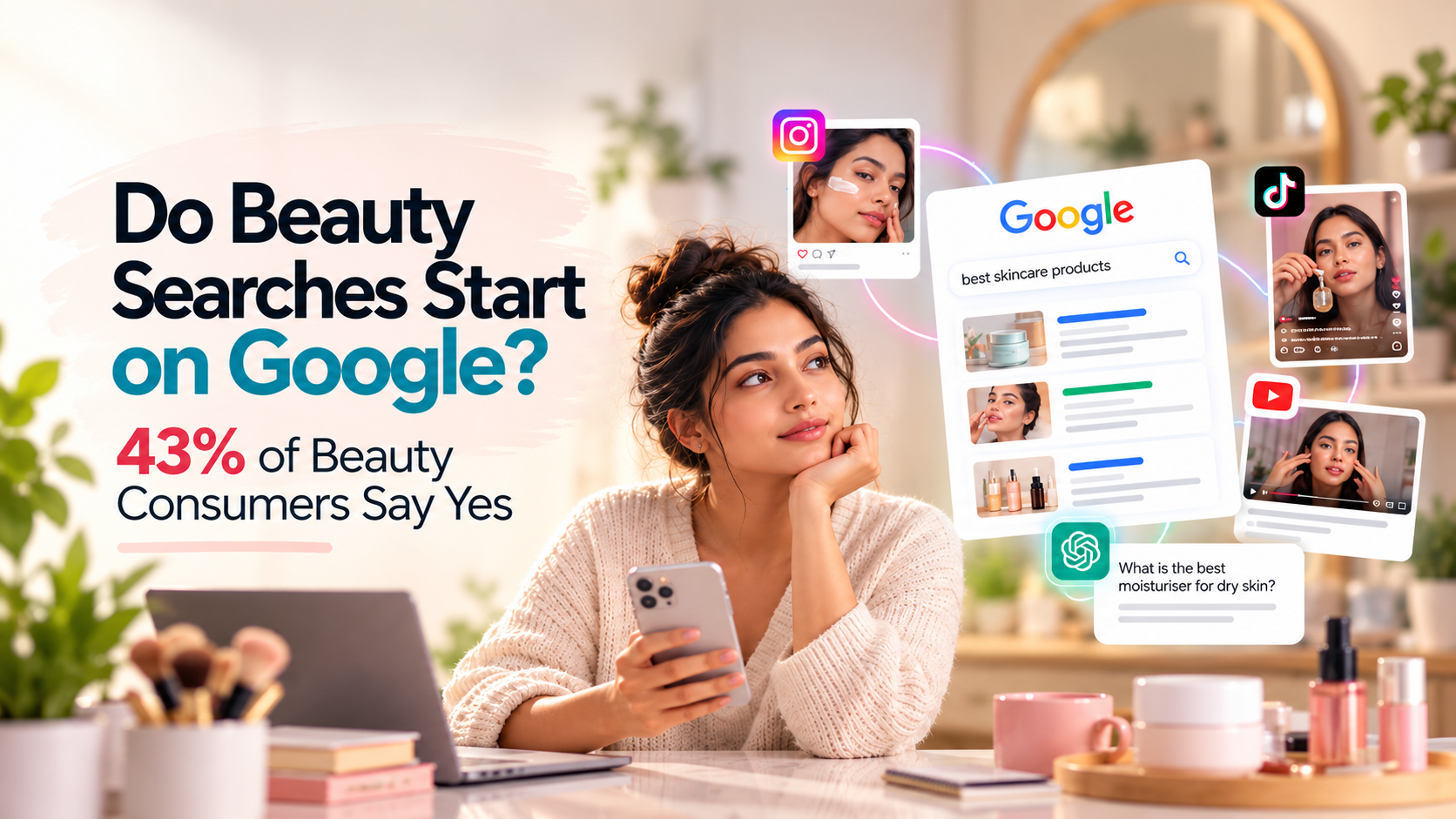
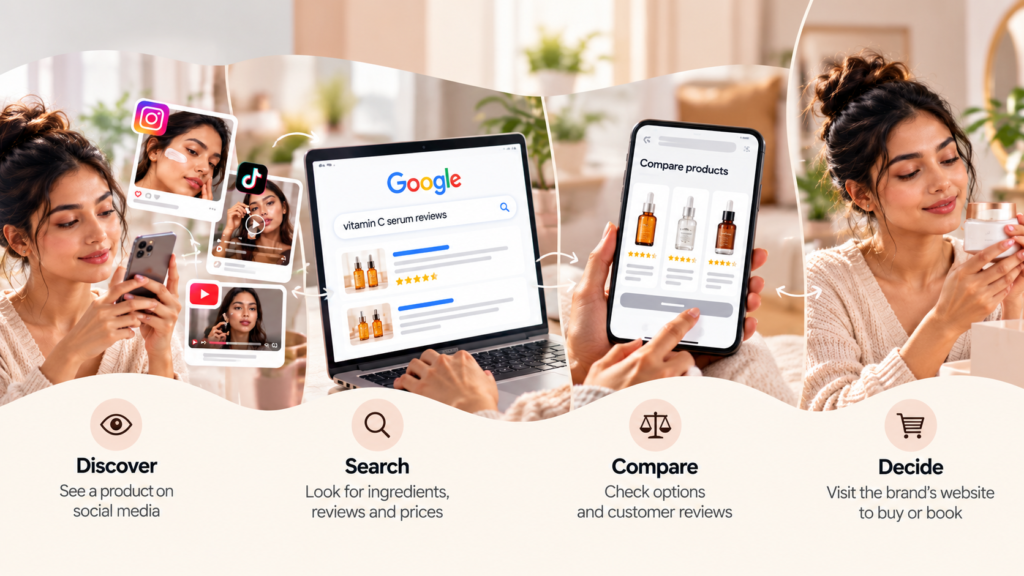
You see a skincare product in an Instagram Reel. A creator explains how it works, a TikTok review adds to your curiosity, and suddenly you want to know more. Before adding it to your basket, you open Google to check the ingredients, the price and what other people think.
Sound familiar?
That journey matters to any beauty brand, salon or clinic, because beauty searches often continue on Google even when discovery starts on social media. A survey of 511 beauty consumers, reported by Search Engine Land, found that 43% went to Google first when they had a beauty question. The same survey, run by Stella Rising, found that 72% of people who discover a product on TikTok search for it on Google next.
So, Where Do Beauty Shoppers Actually Start?
Imagine someone looking for a new moisturizer. They might discover one through a creator’s video, but that first impression does not always lead directly to a purchase. They may want to compare ingredients, check the price, read reviews, or see whether the product is suitable for their skin.
That is where search becomes important.
According to the survey figures reported by Search Engine Land, the first-stop breakdown was:
Platform |
Share of respondents |
| 43% | |
| 11.9% | |
| YouTube | 11.2% |
| TikTok | 10.6% |
| AI tools | 9.8% |
These numbers represent the reported responses of 511 beauty consumers, not the behavior of every beauty shopper or the overall market share of each platform.
Still, the finding raises an interesting question: what happens when someone hears about your brand on social media but cannot easily find useful information about it on Google?
That gap could mean a missed opportunity.
What Happens After the Social Post?
For many shoppers, the social post is the introduction and Google is the check. According to the survey, 72% of people who find a beauty product on TikTok say their next step is a Google search.
That is the moment that matters. If the brand’s website has clear product information, ingredients and reviews, the customer finds what they need. If it does not, they may move on to another brand, even though the brand did all the work of earning their interest
Why Beauty Searches Still Lead to Google
Beauty purchases come with questions. Before buying a serum or booking a treatment, people often search for things like:
-
- “Best moisturizer for dry skin”
-
- “Facial treatment in Leeds”
-
- “Bridal makeup artist in Melbourne”
-
- “What does vitamin C do for skin?”
These searches are different from scrolling for inspiration. The person is actively looking for information to help them decide. A business with clear service pages, helpful content and an easy-to-use website has a chance to become part of that decision.
This is where
help. Search Engine Optimization makes it easier for people to find relevant pages when they are looking for products, services and answers. Google’s own SEO Starter Guide says that creating compelling, useful content is likely to influence a site’s presence in search results more than any other suggestion in the guide.
How Instagram, TikTok, YouTube and AI Tools Fit In
These platforms do different jobs:
-
- Instagram: a visual way to show routines, treatments and results honestly, and to build familiarity.
-
- TikTok: short videos that spark curiosity. Viewers often search Google afterwards.
-
- YouTube: longer tutorials and comparisons for people who want more detail.
-
- AI tools: only 9.8% started there in this survey, but it is a reminder that clear, trustworthy website content helps answer engines as well as people. That is where Answer Engine Optimisation (AEO) comes in.
The useful question is not which platform is most popular. It is whether customers can find your brand at the moments that matter to them.
When a Great Instagram Feed Is Hard to Find on Google
Picture a salon that posts attractive treatment videos on Instagram. One evening, a potential customer decides to book a facial and searches Google for a salon nearby, hoping to compare services, prices and reviews.
If the salon has little search visibility or an incomplete business profile, that customer may book somewhere else. The salon built the interest but was not easy to find when the customer was ready to act.
For local businesses, local SEO matters here. Google explains how local results work in its guide to improving local ranking on Google: they depend on relevance, distance and prominence, so no business or agency can guarantee a particular position. What businesses can do is keep their information accurate and complete:
-
- Keep the name, address, phone number and opening hours up to date.
-
- Choose the most relevant business categories.
-
- Add genuine photos of the premises, team and services.
-
- Collect genuine reviews and reply professionally. Never buy or incentive them.
-
- Link to a clear website or booking page.
Your Website Is Where Interest Becomes Action
Now imagine the customer finds the salon on Google. They click through, but the treatment descriptions are unclear, prices are hard to find and the booking button sits at the bottom of the page. They may leave, even though the salon offers exactly what they need.
A beauty website should do more than look good. It should explain what is on offer, answer common questions, work well on a phone and make the next step easy. The same goes for skincare retailers: clear product descriptions, transparent pricing, ingredient information and a smooth checkout all support people who are already thinking about buying.
How Search and Social Media Work Together
Here is a hypothetical example. A skincare brand launches a new moisturizer:
-
- Awareness: an Instagram Reel shows how to use it.
-
- Research: a viewer searches Google and lands on a product page that covers ingredients, skin types and FAQs.
-
- Confidence: genuine reviews and clear policies reassure them.
-
- Purchase: a simple checkout and easy customer support finish the job.
Each step supports the next. Skip one, and customers can drop out of the journey. No single step guarantees a sale, but connecting them gives people more ways to discover and understand a brand.
What to Keep in Mind
-
- It is one survey. It covers 511 people, mostly women, and results will vary by market, age group and product type.
-
- Social may matter more for some brands. The right balance depends on your audience and your data.
-
- Avoid unsupported claims. Do not promise medical or cosmetic results you cannot back up.
-
- Measure it. Track website visits, enquiries, bookings and sales by channel before changing your plan.
-
- No guarantees. SEO takes time, and nobody can guarantee rankings, traffic or sales.
How AI.Que Media Helps Beauty Businesses Build Online Visibility
At AI.Que Media, we look at digital marketing as one connected customer journey rather than a set of separate tasks. For beauty brands, salons and skincare businesses, that journey can start with a social post, continue with a Google search and end with an enquiry, booking or purchase.
We support it through SEO services and local SEO to help people find you, content marketing that answers customer questions, Google Ads management to reach relevant audiences, and website and conversion improvements that make it easier to enquire or buy. The right mix depends on your audience, goals and data. You can see how we work in our case studies.
A beauty product may first catch someone’s eye on Instagram or TikTok, but the journey rarely ends there. They may turn to Google to check ingredients, compare options, read reviews or find a nearby service.
The finding that 43% of respondents started on Google shows why beauty searches deserve a place in your marketing plan. It does not make social media less important. It shows why the two work best together, and the brands that appear in both places are the ones most likely to be remembered.
Want to make your beauty brand easier to find online? Explore our digital marketing services or contact AI.Que Media to talk through your goals.