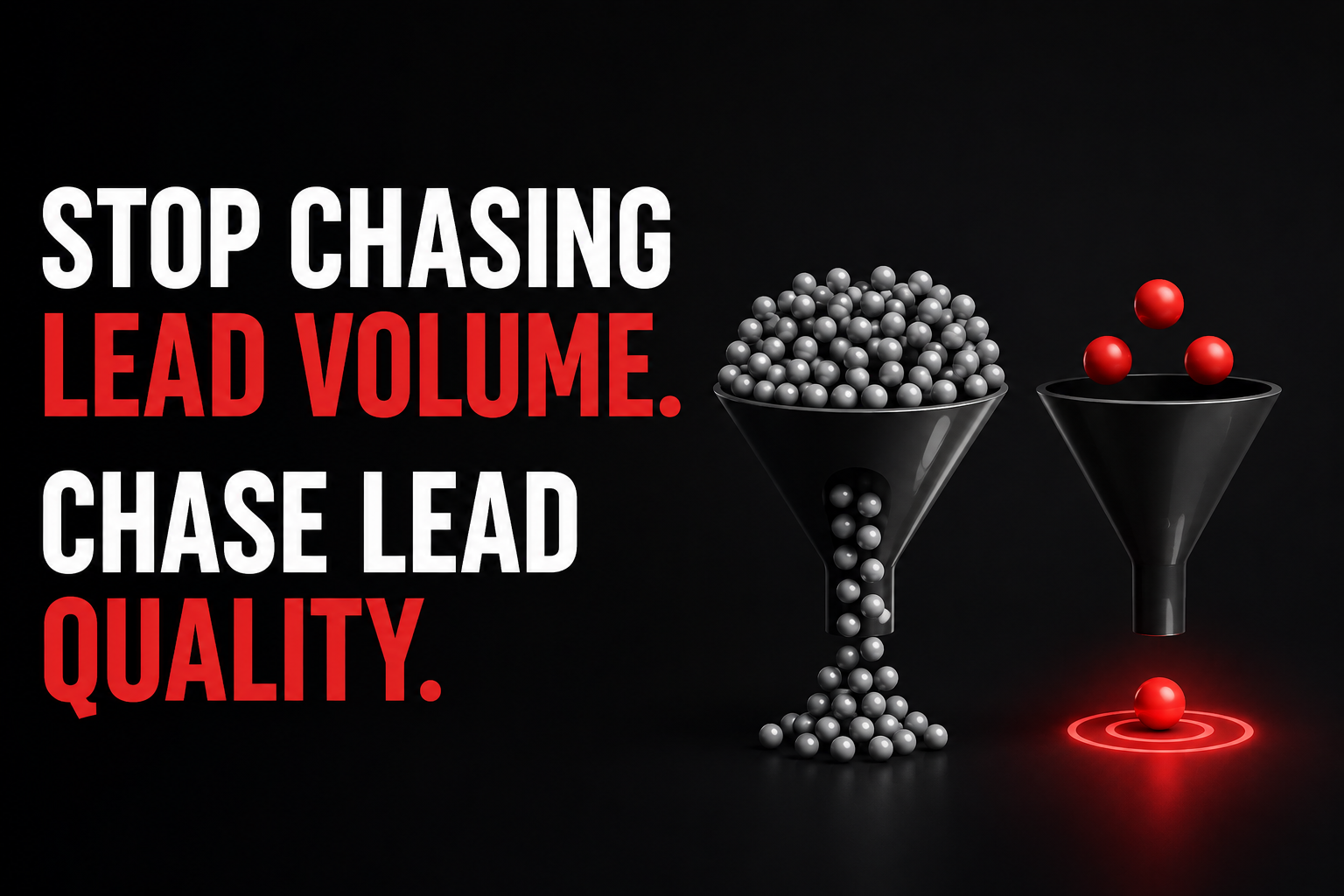
Your campaign generated 500 leads. Sounds great until you discover only 10 were actually relevant.
This is one of the most common traps in digital marketing: mistaking lead volume for lead quality. A high lead count looks impressive in a monthly report. It rarely tells you whether those leads had any real intention of buying, any real budget, or any real fit with what your business offers.
At AI. Que Media, this is a principle we build every campaign around: for international businesses competing for customers across multiple markets, growth doesn’t come from a bigger number at the top of the funnel; it comes from the right people entering it.
The Lead Volume Trap
Most marketing reports lead with the same set of numbers: total leads, cost per lead, form submissions, WhatsApp inquiries, and clicks. These are easy to measure, easy to present, and easy to celebrate.
They’re also incomplete.
None of these metrics tell you whether a lead had genuine buying intent, the authority to make a purchasing decision, or a real need for what you’re selling. A campaign optimized purely to lower cost-per-lead will often succeed by attracting cheaper, less relevant traffic that inflates the numbers without moving the business forward. This is where our performance marketing approach starts from a different question entirely: not “how do we get more leads,” but “how do we get the right leads.”
More Leads Don’t Always Mean More Revenue
The real path from marketing spend to revenue looks like this:
Lead → Qualified Lead → Sales Conversation → Customer → Revenue
Every stage in that chain loses some percentage of leads. The question is which leads survive the journey.
Consider two campaigns:
-
- Campaign A generates 100 leads. Only 8 are genuinely qualified. The sales team spends hours filtering through irrelevant inquiries, and 2 eventually become customers.
-
- Campaign B generates 20 leads, but 15 are genuinely qualified because targeting and messaging were built around a specific audience. The sales team spends less time filtering and more time selling, and 6 become customers.
Campaign B produced far fewer leads and far more customers. This is the core argument for prioritizing quality: a smaller, better-targeted pipeline consistently outperforms a larger, unfiltered one, because every stage downstream becomes more efficient when the input is stronger.
What Makes a Lead “High Quality”?
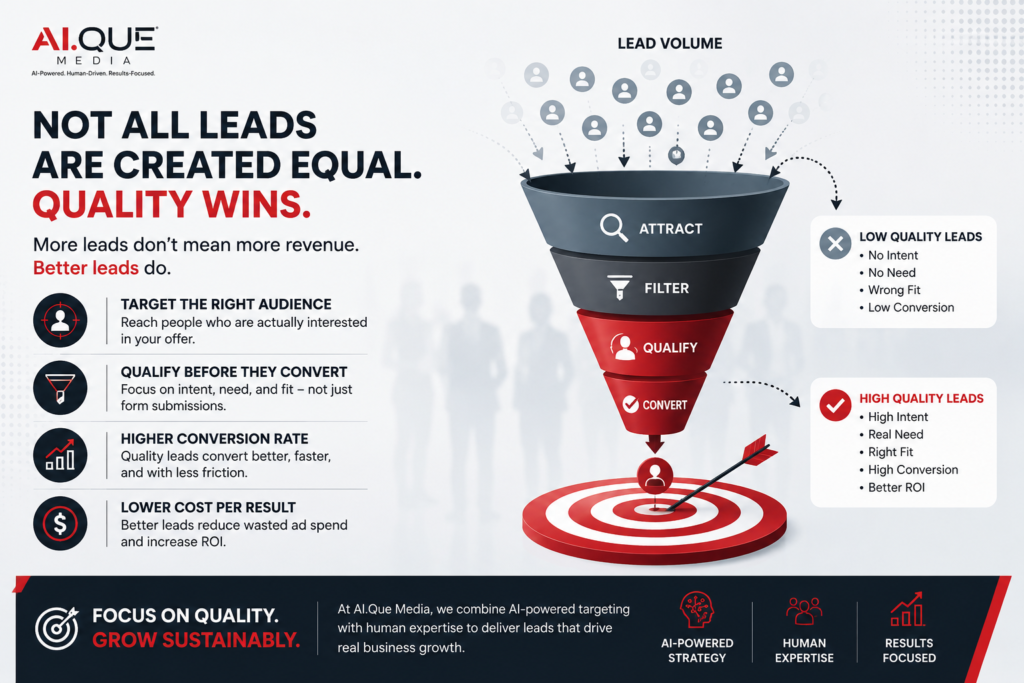
Not every inquiry is created equal. A high-quality lead typically shows several of these signals:
-
- Genuine interest in the specific product or service being offered
-
- Right target audience matching your ideal customer profile, not just anyone who clicked an ad
-
- A relevant need the business can actually solve
-
- Buying intent, not casual curiosity
-
- Budget fit for the pricing tier being offered
-
- Decision-making ability: The person can actually approve a purchase, or has direct access to someone who can
-
- Geographic or service relevance particularly important for businesses serving specific regions or industries
-
- Appropriate timing: The prospect is actively looking now, not “maybe in a year.”
The more of these signals present, the more likely that lead converts into a paying customer.
Why Digital Marketing Can Attract Low-Quality Leads
Low-quality leads aren’t usually a sign that digital marketing “doesn’t work”; they’re usually a sign that something upstream is misaligned. Common causes include:
-
- Broad targeting that casts too wide a net, capturing attention without relevance
-
- Weak messaging that doesn’t clearly communicate who the offer is actually for
-
- Misleading offers that attract clicks but not genuine interest
-
- Poor landing pages that fail to filter or qualify visitors before they submit a form
-
- Incorrect audience targeting: optimizing for a broad demographic instead of an actual buyer profile
-
- Optimizing only for cheap conversions, which rewards volume over relevance
-
- Lack of qualification anywhere in the funnel: no questions, no filters, no friction
-
- Poor campaign-to-landing-page alignment, where the ad promises one thing and the landing page delivers another
Each of these is fixable, and fixing them is usually far more valuable than simply increasing ad spend to generate more raw leads.
How to Improve Lead Quality
1. Define your ideal customer
Every high-performing campaign starts with a clear picture of who the business is actually trying to reach: industry, company size, role, budget range, and specific pain points. Without this, targeting becomes guesswork.
2. Improve targeting
Audience intent, demographics, interests, and search behavior should all inform who sees a campaign and, just as importantly, who’s excluded from it. Exclusions are often the most underused lever in a targeting strategy.
3. Make your messaging more specific
Clear, specific messaging naturally discourages irrelevant prospects from clicking while attracting the right ones. Vague, broad messaging invites vague, broad interest.
4. Qualify leads earlier:
Forms with the right qualifying questions, landing-page messaging that pre-filters visitors, and clear intent signals all help separate serious prospects from casual browsers before they ever reach a sales conversation. Established frameworks like BANT-based lead qualification offer a useful starting structure for what to ask and when.
5. Optimize for business outcomes, not just CPL
Move beyond cost-per-lead as the primary success metric. Track qualified lead rate, conversion rate, cost per qualified lead, sales-qualified leads, customer acquisition cost, and ultimately revenue generated.
6. Connect marketing with sales.
Sales teams know which leads actually convert and which waste their time. That feedback loop is one of the most valuable, most underused inputs for improving campaign quality over time.
Lead Quality Across Different Channels
Lead quality isn’t a single, uniform concept; it looks different depending on the channel:
-
- Google Ads: intent signals come from search terms themselves; quality depends heavily on keyword relevance and how well your landing page experience matches what the ad promises
-
- Meta Ads: quality depends on precise audience building and creative that filters as much as it attracts
-
- SEO: organic visitors often arrive with pre-existing intent, but content needs to answer the right questions to attract the right audience
-
- Content marketing: quality comes from depth and specificity, drawing in readers genuinely evaluating a solution
-
- LinkedIn: particularly relevant for B2B and SaaS businesses, where precise targeting by job title, industry, and seniority allows for far more accurate audience building than platforms relying on interest-based targeting alone
-
- AI Search / Answer Engine Optimization: as AI tools increasingly recommend businesses directly, being cited for the right, specific queries matters more than broad visibility
Each channel requires its own qualification signals; treating them all the same is one of the fastest ways to dilute lead quality across a campaign.
The AI.Que Media Approach
We don’t simply ask, “How many leads did we generate?”
We ask, “How many of those leads were actually worth pursuing?”
This shapes how we approach every part of a campaign, from SEO and AI search optimization built around genuine buyer intent to Google Ads and paid advertising targeted with precision rather than reach to conversion-focused landing pages designed to qualify visitors rather than just collect emails. Our content marketing work follows the same principle built to attract the right readers, not just more of them.
This is audience-first marketing: intent-driven campaigns, data-led optimization, and continuous refinement based on what actually converts, not just what looks good in a weekly report. We don’t guarantee a specific number of qualified leads or a specific revenue outcome; no responsible marketing partner can. What we do is build campaigns around the belief that better leads, better conversations, and better conversions are what sustainable growth is actually built on, whether a business is targeting customers locally or across international markets. You can learn more about our approach on our About Us page.
The Metrics That Matter More Than Lead Count
| Vanity metric | Better business metric |
| Total leads | Qualified leads |
| Cost per lead | Cost per qualified lead |
| Clicks | High-intent visits |
| Form submissions | Sales-qualified leads |
| Conversion volume | Lead-to-customer rate |
| Ad spend | Revenue / ROI |
The metrics on the left are easy to report and easy to inflate. The metrics on the right are harder to game, and they’re the ones that actually reflect whether marketing is contributing to business growth.
Don’t Celebrate a Bigger Number
If your sales team can’t use the leads you’re generating, the lead count doesn’t matter no matter how good it looks in a dashboard.
Sustainable growth, for businesses competing in international markets or closer to home, comes from attracting the right people, not simply more people. Better leads lead to better conversations. Better conversations lead to better conversions. Better conversions lead to growth that actually holds up over time.
Want to improve the quality of your digital marketing leads? Explore AI. Que Media’s performance marketing and lead-generation solutions, or get in touch through our contact page to talk about what quality-focused marketing could look like for your business.