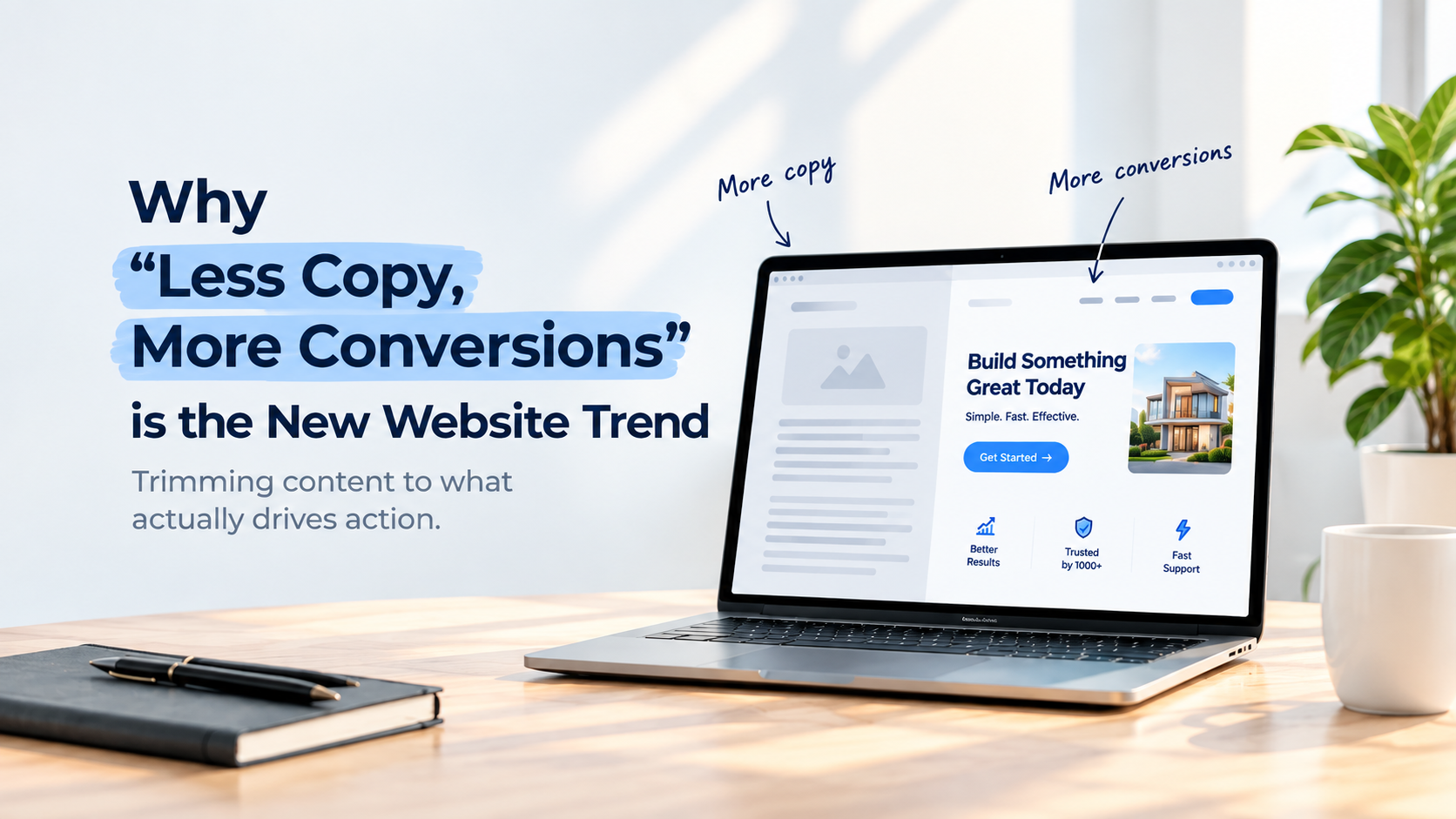
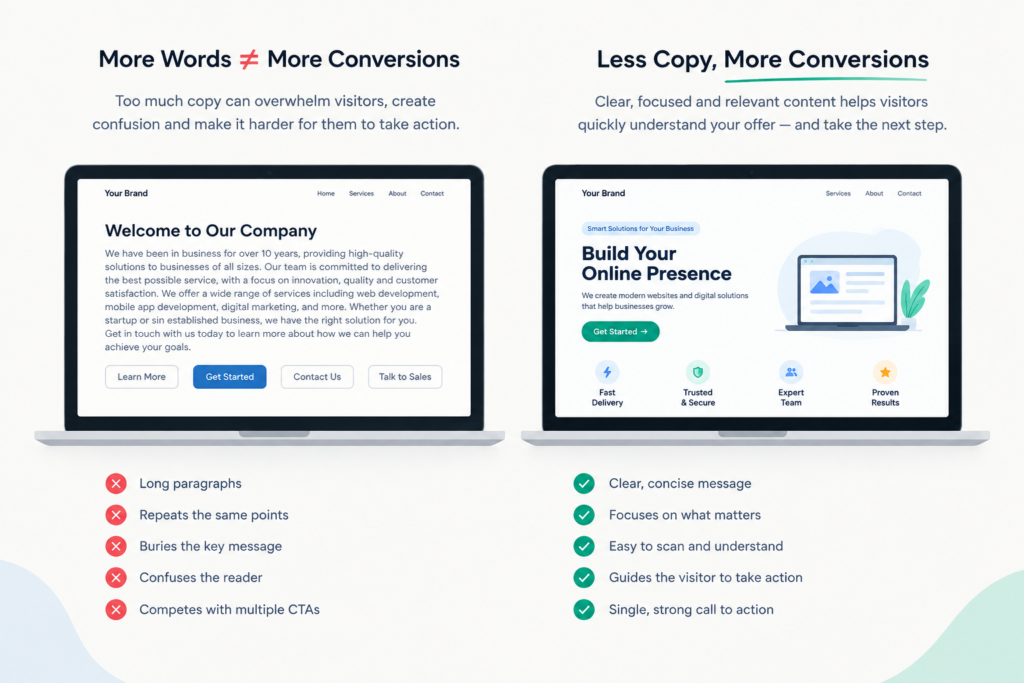
Many websites try to say everything,long company histories, repeated benefits, feature lists nobody reads, and three or four CTAs competing for attention at once.
But more words don’t mean more conversions.
That’s the idea behind conversion-focused website content: not shorter content for its own sake, but content stripped of everything that doesn’t help a visitor understand the offer and decide what to do next. The goal isn’t less information. It’s less friction.
What Does “Less Copy, More Conversions” Actually Mean?
It’s worth being precise here, because this trend is easy to misread.
“Less copy, more conversions” does not mean:
- Removing important information
- Making a website vague or generic
- Eliminating SEO content
- Writing extremely short pages regardless of what they need to do
- Hiding product or service details
It actually means:
- Removing unnecessary words that don’t add meaning
- Eliminating repetition saying the same thing once, clearly, instead of three times
- Prioritizing the information visitors actually need first
- Improving content hierarchy, so the most important points are the easiest to find
- Making benefits easier to understand at a glance
- Using clear, specific calls to action
- Answering the visitor’s actual question quickly
- Matching content to search intent, rather than writing in the abstract
There’s a real difference between short content and efficient content. Short content is simply brief. Efficient content says exactly what needs to be said, in the order a visitor actually needs it, and nothing more.
Why Too Much Website Copy Can Hurt Conversions
Excessive content doesn’t just take longer to read, it actively works against the outcome a business wants.
Long, undifferentiated blocks of text create:
- Cognitive overload: The visitor has to work to figure out what matters
- Decision fatigue:Too many options or explanations make it harder, not easier, to choose
- Confusion: when every paragraph seems equally important, nothing does
- Weak content hierarchy: key information gets buried next to minor details
- CTA blindness:when calls to action appear everywhere, visitors stop noticing any of them
- Longer paths to action:Every extra paragraph is one more thing standing between a visitor and a decision
- Reduced mobile usability:Dense text is harder to scan on a small screen
- Difficulty identifying the value proposition: the single most important sentence on the page gets lost
This matters because visitors don’t read websites the way they read a book. Research from the Nielsen Norman Group has consistently found that users scan web pages rather than reading word for word, typically absorbing only a fraction of the text on a given page. People are looking for signals headings, bold phrases, clear structure that tell them where the information they need actually is.
A practical example: instead of a 300-word explanation of a service, a page could communicate the same substance far more efficiently as:
What we do → Who it’s for → Why it matters → Proof → Clear next step
Same information. Far less friction.
Less Copy Does Not Mean Less SEO
This is worth addressing directly, because it’s a common and costly misunderstanding: businesses sometimes delete website content on the assumption that shorter pages automatically rank better. That isn’t how search works.
SEO still depends on:
- Matching content to genuine search intent
- Topical relevance and depth where a topic requires it
- Content that’s genuinely helpful, not just present a principle Google’s own Search Central guidance is explicit about
- Semantic relevance across related terms and concepts
- Internal linking that connects related pages logically
- Clear heading hierarchy (H1, H2, H3) that search engines can parse
- Supporting content: service pages, location pages, FAQs
Conversion optimization and SEO aren’t in conflict; they should work together. A page can be concise above the fold, communicating its core message quickly, while still offering comprehensive supporting information further down the page for visitors who want more detail before deciding.SEO Services work and Conversion Rate Optimization work are most effective when planned together, not treated as separate, competing priorities.
After: “Buying or selling a home? We’ll guide you through every step from first viewing to closing day. Browse current listings or talk to an agent today.”
In each case, the “after” version drops generic, self-congratulatory language in favor of specific outcomes and a clear next step. The visitor spends less effort figuring out what’s being offered, which leaves more attention available for actually deciding.
When Long-Form Content Is Still Necessary
“Less copy, more conversions” is not a universal rule, and treating it as one would be a mistake. Long-form content remains genuinely valuable for:
- Educational guides
- Complex or technical services
- Technical products that require real explanation
- Healthcare information
- Legal information
- Industry research
- Comparison pages
- Pillar content supporting a broader topic cluster
- Informational search queries that expect depth
The underlying principle holds across both cases: reduce unnecessary copy, not useful information. A detailed guide that thoroughly answers a complex question isn’t bloated it’s doing its job. A homepage that repeats the same benefit four times in different words is.
How AI.Que Media Approaches Conversion-Focused Websites
At AI.Que Media, we treat conversion-focused content as something that has to be built across several disciplines at once, not addressed by copywriting alone. Our work combines SEO Services, Conversion Rate Optimization, Web Development AEO, GEO, and Performance Marketing because a website’s content, structure, design, and visibility all shape whether a visitor actually takes action.
The goal isn’t simply to bring visitors to a website. It’s to create a digital experience that helps those visitors understand what’s being offered, trust the business behind it, and take a clear next step whether that’s booking a call, requesting a quote, or making a purchase.
We work with businesses based in India as well as international markets including the UK, USA, Canada, and UAE, each with different audiences, buying behaviors, and expectations. The right amount of website content always depends on context, industry, search intent, the complexity of what’s being offered, and where a visitor is in their decision rather than a fixed rule about word count.