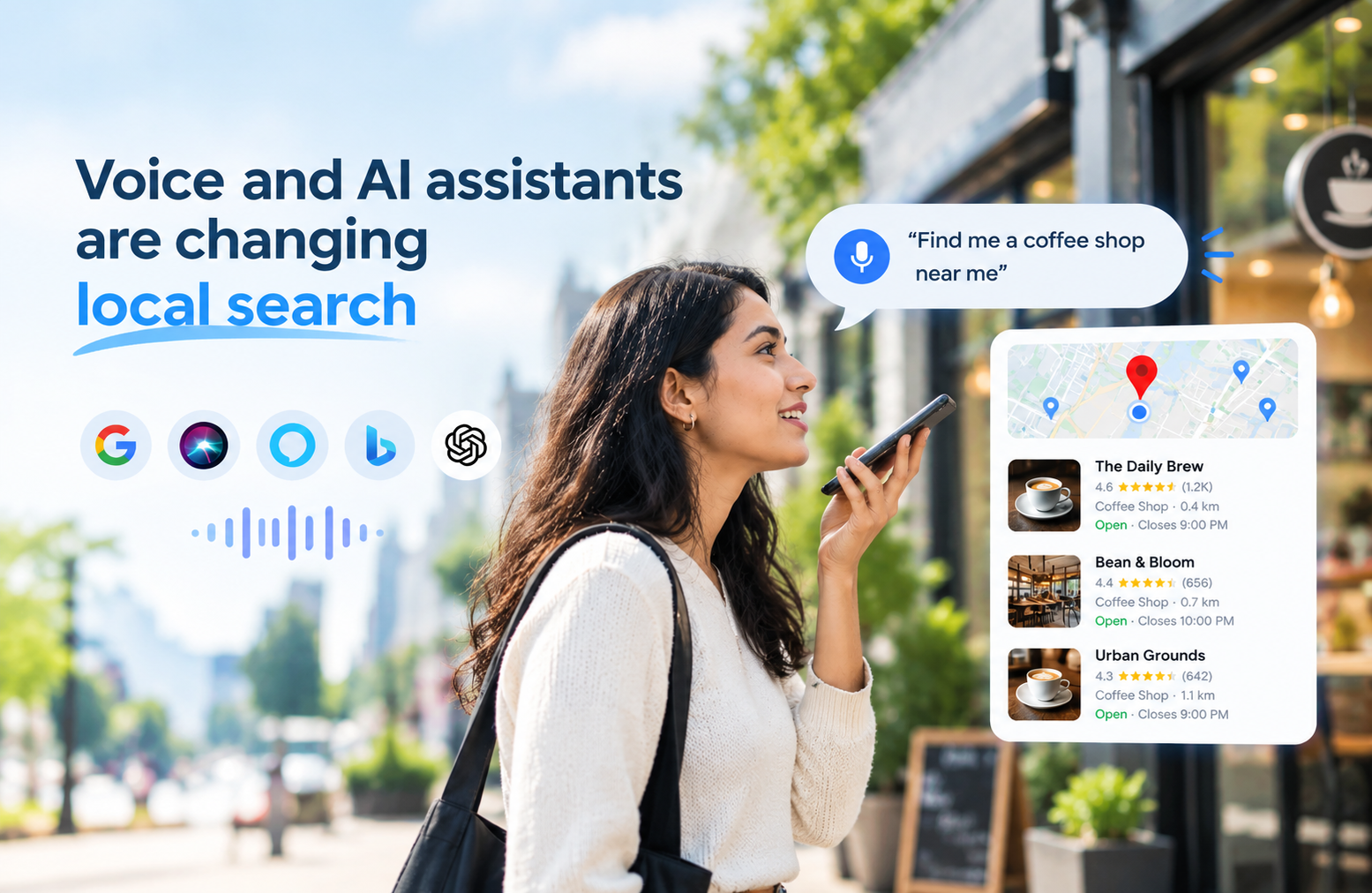
Picture this: someone says, “Find me a plumber near me who’s open now,” to Siri, Google Assistant, Alexa, or asks the same question conversationally in ChatGPT or Gemini. Within seconds, they get an answer, often a single recommendation, not a list of ten blue links to scroll through and compare.
This is a fundamentally different search experience than typing “plumber [city]” into a search bar and browsing results yourself. The assistant is making a judgment call on your behalf, and that changes what businesses need to do to be found.
At AI.Que Media, we work with businesses across international markets who are asking the same question: how do we stay visible when customers aren’t typing anymore, they’re asking?
What Is Voice Search and AI-Powered Local Search?
Voice search lets users find information by speaking naturally instead of typing keywords. AI-powered local search uses that same conversational understanding to match spoken or chat-based queries with relevant nearby businesses.
Traditional search was built around keywords, type a few words, and get matching pages. Voice and conversational AI search work differently. A person doesn’t say “best pizza Manchester.” They ask, “What’s a good pizza place near me that delivers late?”
That single query carries intent (they want food now), context (delivery, late hours), and location (near me) all at once. AI assistants have to interpret this together, not just match words which is why location accuracy, structured business information, and genuine relevance matter more than exact-match keywords here.
The customer journey is shifting too. Instead of a results page, comparison, and a phone call, one AI-generated answer can be the entire interaction: a single response, a single decision.
The Rise of “Near Me” and Conversational Searches
Users are increasingly replacing short “near me” searches with longer, more specific conversational questions that include qualifiers like ratings, availability, and urgency.
The shift looks like this across industries:
- Restaurants: “restaurants near me” → “Where can I get a table for four tonight that takes walk-ins?”
- Healthcare: “dentist near me” → “Which dentist near me accepts new patients and is open on Saturdays?”
- Home services: “electrician near me” → “Who’s a reliable electrician near me for an emergency call tonight?”
- Real estate: “real estate agent near me” → “Who’s a top-rated real estate agent near me who specializes in first-time buyers?”
- Legal services: “lawyer near me” → “Who’s a good immigration lawyer near me with experience in UAE visa cases?”
- Beauty salons: “hair salon near me” → “What’s a highly rated hair salon near me that’s open late on Fridays?”
- Automotive services: “car repair near me” → “Where can I get my car fixed near me today without an appointment?”
- Professional services: “accountant near me” → “Who’s a small business accountant near me that works with startups?”
Each of these longer queries carries more specific intent. A business that only optimizes for the short keyword version is missing most of what the assistant is actually trying to match.
How AI Assistants Choose and Present Local Businesses
AI assistants and search engines rely on a combination of verified business information, relevance to the query, location data, reviews, and website content, not a single hidden ranking trick.
According to Google’s own guidance for business owners, local search results are based primarily on relevance, distance, and prominence, and there is no way to pay or “hack” your way into a better local ranking. The same principle extends to AI assistants and answer engines: the businesses most likely to be surfaced are the ones with the clearest, most consistent, and most complete information available.
Factors that consistently matter include:
- Google Business Profile completeness and accuracy
- NAP consistency (business Name, Address, Phone number matching everywhere online)
- Website content that clearly explains services and location
- Local landing pages for each service area, where relevant
- Reviews both quantity and how recently they were left
- Business categories that accurately reflect what you do
- Services and opening hours, kept current
- Structured data / schema markup, which helps machines (not just humans) understand your business
- Local citations and authority mentions of your business on other credible sites
- Overall customer experience and relevance to the specific query asked
It’s worth being clear: there is no single guaranteed ranking factor, and no legitimate way to “hack” an AI assistant into recommending a business that doesn’t genuinely match what the customer is looking for. The businesses that consistently show up are simply the ones that make it easiest for both search engines and AI systems to understand who they are, what they do, and where they operate.
Why Traditional Local SEO Alone May Not Be Enough
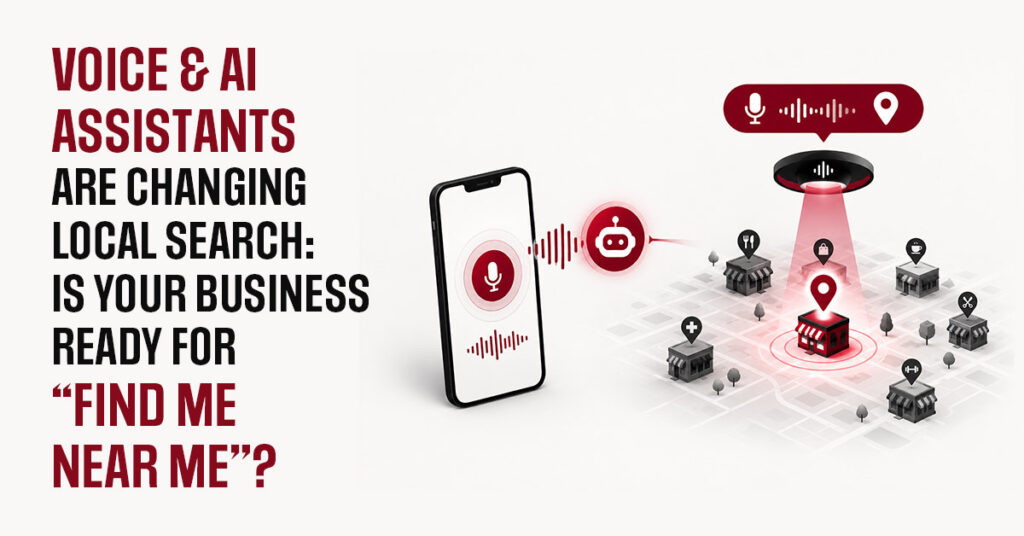
Traditional local SEO focuses on ranking in Google’s results, but AI assistants and answer engines need content that clearly explains who a business serves, what it offers, and why it’s relevant, not just keyword-optimized pages.
Ranking #1 in a traditional Google search result is still valuable, but it’s no longer the only outcome that matters. Increasingly, businesses need their content to answer a broader set of implicit questions that AI systems are trying to resolve:
- Who does this business actually serve?
- What specific services does it provide?
- Where does it operate, precisely?
- What makes it relevant to this particular question?
- What do customers commonly ask about this business or service?
- What credibility or expertise does it demonstrate?
A page built purely around a keyword phrase, without answering these underlying questions in plain language, gives an AI system very little to work with when it’s deciding what to say in a conversational answer.
How to Optimize Your Business for Voice and AI Search
A practical voice and AI search strategy combines a strong Google Business Profile, conversational content, consistent business data, structured markup, and ongoing attention to reviews and site performance.
A working checklist:
- Optimize your Google Business Profile : complete every field, keep hours and services current, and respond to questions and reviews
- Create useful local service pages : one per service/location combination where relevant, not just a single generic “Services” page
- Answer conversational questions directly : use the actual phrasing customers use when they ask, not just formal keyword phrases
- Write in natural language: content should sound like how a person would actually explain the business, not a keyword list
- Strengthen reviews and reputation : actively request reviews, and respond to all of them, positive and negative
- Implement relevant schema markup : particularly LocalBusiness structured data, which helps both search engines and AI systems understand core business facts
- Maintain consistent business information : same name, address, and phone number everywhere your business is listed
- Create location-specific content : genuinely useful pages for each city or region you serve, not thin, duplicated templates
- Improve website speed and mobile experience : a slow or clunky site undermines everything else
- Build topical authority: publish content that demonstrates real expertise in your service area over time
- Monitor local search visibility : track how and where your business appears, including in AI-generated answers where tools allow it
- Optimize content for AI search and answer engines specifically : write clear, extractable answers near the top of relevant sections
Examples of Voice Search-Ready Content
Voice-ready content answers a question directly, in natural language, rather than simply describing a service in keyword form.
| Traditional Phrasing | Conversational, Voice-Ready Phrasing |
|---|---|
| “Emergency plumbing services in Dubai.” | “Need an emergency plumber in Dubai right now? Our team is available 24/7 and typically arrives within the hour.” |
| “Divorce lawyer London.” | “Looking for a divorce lawyer in London who offers a free initial consultation? Here’s what to expect from the process.” |
| “Same-day dry cleaning Toronto.” | “Need your dry cleaning done today in Toronto? Drop it off before 10 AM and it’s ready by 5 PM.” |
| “Dentist accepting new patients in Trivandrum.” | “Looking for a dentist in Trivandrum accepting new patients? We offer same-week appointments for first-time visits.” |
| “Car AC repair Abu Dhabi.” | “Is your car’s AC not cooling in Abu Dhabi’s heat? We diagnose and repair most AC issues the same day.” |
The pattern is consistent: lead with the question a real customer would actually ask, then answer it directly and specifically.
Voice Search + AI Search + Local SEO: How It All Connects
SEO – Traditional SEO, local SEO, voice search, answer engine optimization, and generative engine optimization are overlapping, connected disciplines, not separate marketing channels.
It can help to think of this as a spectrum rather than separate boxes:
Traditional SEO → Local SEO → Voice Search → Answer Engine Optimization (AEO) → Generative/AI Search (GEO)
A strong foundation, accurate business data, clear content, genuine relevance, supports all of these simultaneously. A business doesn’t need five separate strategies. It needs one coherent approach to being clearly understood by both people and machines, applied consistently across its website, its Google Business Profile, and the platforms where it’s mentioned.
Common Mistakes Businesses Make
- Outdated Google Business Profile information : wrong hours, old phone numbers, or unclaimed listings
- Missing service or location pages : forcing every query into one generic homepage
- Generic website content : copy that could describe any business in the industry, anywhere
- Ignoring customer questions : not addressing the things people actually ask before choosing a business
- Inconsistent business information : different addresses or phone numbers across directories
- Poor review management : not responding to reviews, or having too few recent ones
- Focusing only on keywords instead of intent : optimizing for a phrase rather than the question behind it
- Neglecting mobile experience : since most voice and local searches happen on mobile devices
- Publishing content without clear local relevance : generic blog posts with no connection to where the business actually operates
How AI.Que Media Can Help
AI.Que Media is a digital marketing agency based in Trivandrum, Kerala, working with businesses in India and internationally across the USA, UK, Canada, and the UAE. We help businesses build visibility across the full spectrum described above, including your business needs to be more visible when customers search, ask, or speak to AI assistants, AI.Que Media can help you build a search strategy designed for the evolving digital landscape.