Here’s a number worth sitting with: it took Google Ads roughly five years to reach $1 billion in annual revenue. ChatGPT Ads did it in under 200 days.
That’s not just a business headline. It’s a sign of how fast something genuinely new is happening and it affects a lot more people than just marketers. If you use ChatGPT, work at a company that might advertise, run a small business, or you’re just curious about where AI is heading next, this is worth understanding.
The Short Version
- Ads on ChatGPT are always clearly labeled “Sponsored” and, per OpenAI, never change what ChatGPT actually tells you
- They started as a small test in the US in February 2026 and are now live in dozens of countries
- Ads are matched to what you’re actually talking about not by digging through your private chat history
- OpenAI is explicit that it doesn’t sell user data, and advertisers never see anyone’s individual conversations
- Pricing is still settling, there’s a confirmed minimum in some countries, but no fixed “average cost” everywhere yet
- This is a new place for businesses to be found not a replacement for search engines, social media ads, or anything else already out there
Wait, Ads Are Coming to ChatGPT?
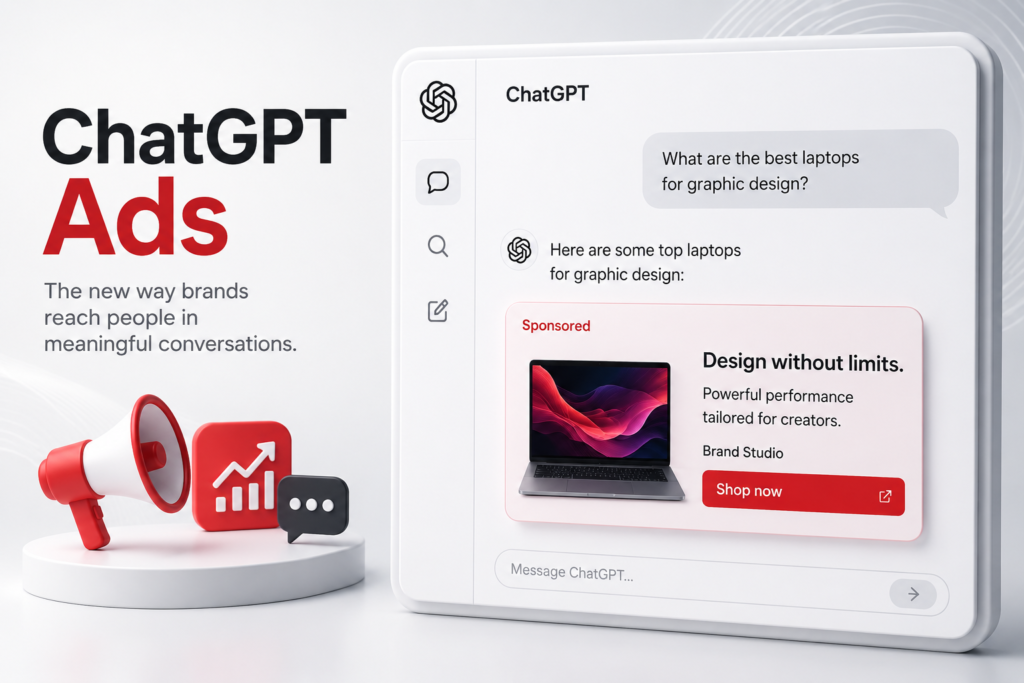
Yes. Since early 2026, some ChatGPT users have started seeing small, clearly labeled “Sponsored” suggestions show up underneath ChatGPT’s answers, similar in spirit to how Google shows sponsored results above your search results, or how Instagram shows you the occasional sponsored post between friends’ photos.
A few things worth knowing if you’re someone who just uses ChatGPT:
- Ads only appear on the free version of ChatGPT. If you pay for ChatGPT Plus, Pro, Business, or use it through school (Education), you won’t see them.
- They’re always clearly marked “Sponsored”, you’ll never mistake one for ChatGPT’s actual answer.
- OpenAI has confirmed that paying for an ad cannot change what ChatGPT actually tells you, answers are optimized for what’s most helpful, not for who’s paid to be there.
- You can hide an ad, report it, or just ask ChatGPT questions about it if you’re curious.
- OpenAI has said there will always be an ad-free way to use ChatGPT, whether that’s a paid plan or a limited free option.
Why Is This Happening?
ChatGPT now has more than a billion people using it every week ,most of them for free. Running something at that scale costs a huge amount of money, and OpenAI needed a way to keep offering free access without charging everyone. Sound familiar? It’s the same basic trade-off that’s funded free Google Search, free YouTube, and free Instagram for years.
What’s genuinely surprising is how fast this new advertising business has grown: Google Ads took about five years to reach $1 billion in yearly revenue. ChatGPT Ads got there in under 200 days. That tells you two things: a huge number of people are already using ChatGPT daily, and businesses are moving fast to reach them there.
Interestingly, OpenAI once described advertising as a “last resort,” worried it might hurt people’s trust in ChatGPT. That’s part of why ads were rolled out carefully, starting small in the US, then expanding gradually rather than all at once.
How Does It Actually Work?
In simple terms, here’s the journey: a business sets up an ad and a budget → ChatGPT looks for genuinely relevant conversations → a labeled “Sponsored” suggestion appears at the right moment → someone can click through to the business’s website → the business can see what happened after that click.
Businesses choose their budget, write their ad, and pick which countries they want to reach. ChatGPT then decides, conversation by conversation, whether an ad is genuinely relevant enough to show , it’s not about typing the “right” keyword, it’s about what the conversation is actually about.
Where Exactly Do the Ads Show Up?
Ads appear as a separate box below a ChatGPT answer, only when OpenAI’s system finds something genuinely relevant , not on every reply, and never to paid or school accounts. It’s a lighter touch than Instagram or Facebook, where ads show up repeatedly across your Feed, Stories, and Reels as you scroll.
Who’s a Good Fit to Advertise Here?
Right now, the businesses that fit best include:
- Online stores and consumer brands : helpful when people are comparing products
- Software and tech companies : useful when someone’s researching tools
- Travel businesses : a natural fit for trip planning questions
- Courses and educational products : apps, online learning, digital products
- Local services : for people looking for something nearby
- B2B companies : increasingly relevant as business research moves into AI chats too
Some industries, healthcare, finance, and legal services, get extra, case-by-case review before approval. And a handful of categories aren’t allowed at all: adult content, gambling, alcohol, tobacco, illegal drugs, weapons, and political ads. Ads also won’t appear in sensitive conversations, like ones about someone’s health or mental wellbeing.
How Are Ads Actually Matched to People?
This works differently than you might expect from other platforms. Instead of businesses picking specific keywords or detailed profiles of who to target, ChatGPT looks at what the conversation itself is actually about, plus which country you’re in.
The important privacy point, worth repeating: advertisers cannot see your private conversations. OpenAI is explicit about this: advertisers never receive your chats, chat history, memories, name, email, or sensitive information, only aggregated numbers, like total views or clicks.
What Does It Cost?
Honestly, this part is still settling. Here’s what’s actually confirmed:
- ChatGPT Ads run on CPM (cost-per-thousand-impressions) or CPC (cost-per-click) bidding, confirmed directly by OpenAI
- In India, there’s a confirmed minimum daily budget of ₹725, about $7.60, when the self-serve Ads Manager opened there
- In the US, an earlier large minimum spend requirement has since been removed, making it easier for smaller businesses to get started
- Costs will likely depend on the market, how many other businesses are competing for the same space, and the industry involved
Be cautious of anyone confidently quoting you “typical” costs online, actual pricing is decided by an auction and varies by category, not a fixed rate.
Where’s It Available?
Testing began in the US on February 9, 2026, and has since expanded market by market including Canada, Australia, New Zealand, the UK, Japan, South Korea, Mexico, Brazil, most of Europe, and India, with the list still growing.
Does This Replace Google Ads or Regular Advertising?
No and this is worth understanding whether you’re a business owner or just someone who works in marketing. Search ads are still the strongest, most measurable option when someone already knows exactly what they want and types it into a search bar. ChatGPT Ads offer something different: a chance to reach someone earlier, while they’re still exploring and asking questions, often before they’ve even opened a search engine.
This is a genuinely new place people are searching, not a replacement for the places they already search. Someone might still Google something later, or scroll past an ad on Instagram ChatGPT is simply becoming one more place where that conversation now happens.
The Upside, Realistically
- Higher intent : people often arrive already describing a specific problem, more context than a short search ever gives
- Well-timed : ads can show up right as someone’s actually deciding, not just browsing
- Less crowded, for now : far fewer businesses are advertising here than on more established platforms
- One setup, many countries : a business can test the same campaign across many markets from one account
- A real shot for smaller brands : businesses that struggle to compete in a crowded search auction may find easier visibility here
Worth being honest: these are genuine early-stage advantages, not guarantees. Results will vary by business and market, especially while the platform is still new.
What to Keep in Mind
- It’s still early. The tools for building and measuring these campaigns are actively being improved.
- There’s no long track record yet to compare results against, unlike more established platforms.
- Availability still varies by country, some places have full access, others are still rolling it out gradually.
- A few restrictions apply, as mentioned above, certain industries and categories face limits or outright bans.
- Measurement tools are still maturing , not yet as detailed as what’s available elsewhere.
- OpenAI is being deliberately cautious here, since people use ChatGPT for advice and problem-solving , which also means the ad experience itself is more limited than on other platforms, on purpose.
How This Connects to Getting Found by AI, Organically
There’s a difference between paying to show up in ChatGPT and being naturally recommended by it. That second part , often called AI Search Optimization, along with SEO and AEO , is about earning genuine visibility organically, the same way strong SEO earns a business a spot in Google’s results without paying for an ad.
The two work well together, not against each other. A business with strong organic AI visibility is more likely to get mentioned naturally within ChatGPT’s answers; running ads on top of that can reinforce that visibility at the same moment. Neither replaces the other, much the way paid search and organic SEO have coexisted for two decades.
How AI.Que Media Can Help
Because this is such a new, fast-moving space, having an experienced team involved can save a lot of trial and error. That includes:
- Figuring out whether this channel is even available yet in a given market
- Understanding the kinds of questions real customers are actually asking
- Writing ads and building landing pages suited to this new, conversational format
- Setting up proper tracking so results are actually measurable
- Making sense of early results without established benchmarks to compare against
- Managing campaigns across multiple countries with different rules and access levels
At AI.Que Media, we bring this together with our existing work in AI Search Optimization, SEO, and performance marketing , so a new channel like this becomes part of a coordinated strategy, not a disconnected experiment. You can see how this approach has worked for other clients in our Case Studies.
Five years versus 200 days isn’t just an impressive statistic, it’s a sign that a lot of daily life is quietly shifting toward AI conversations, faster than most people have noticed. Whether you’re a student using ChatGPT for homework, a business owner wondering where your next customer will come from, or just someone paying attention to where technology is heading, this is one of those shifts worth understanding early.
Curious what this could mean for your business? Get in touch with AI.Que Media to talk through what AI-powered search and advertising could look like for you.