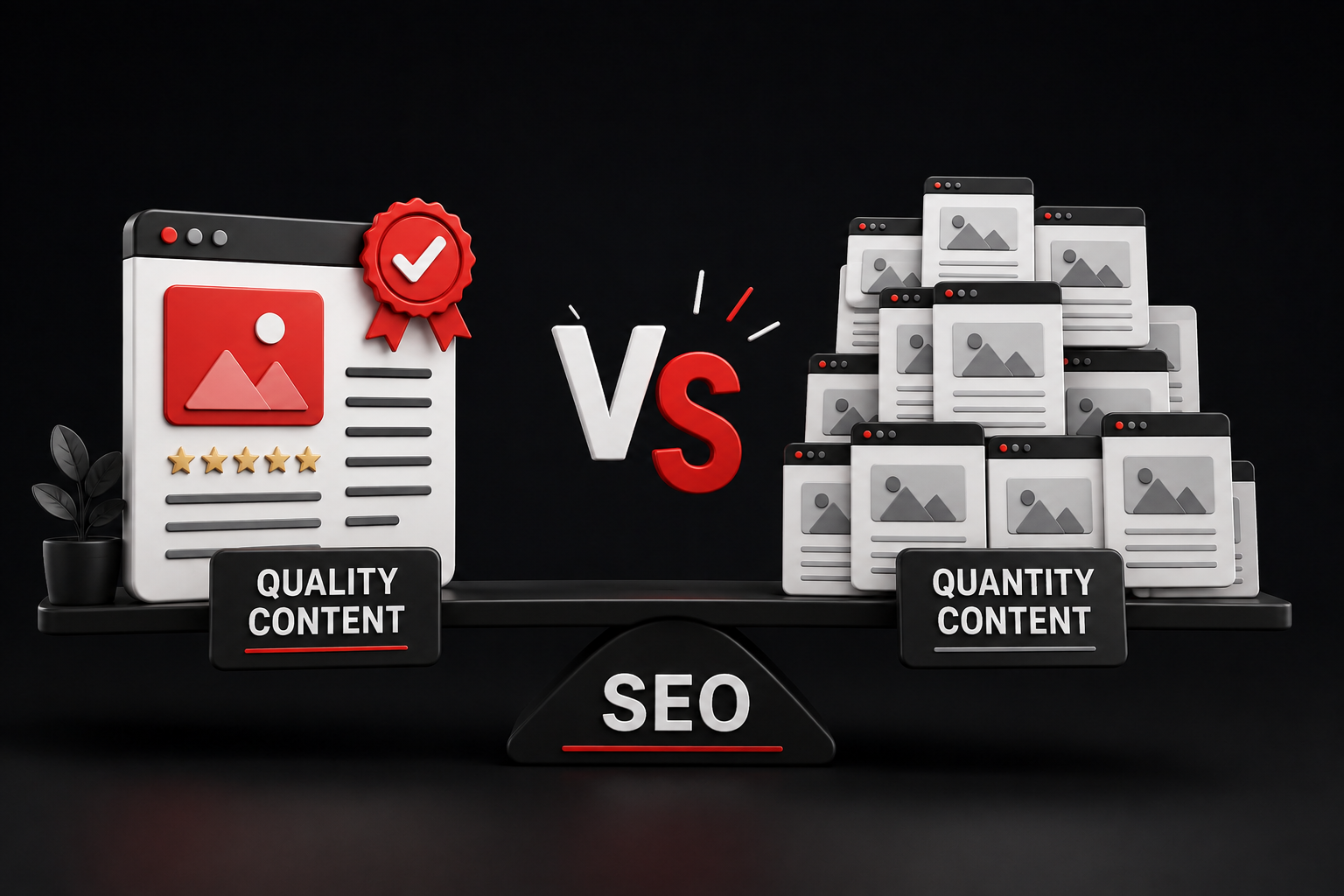
Publishing 50 generic blog posts does not automatically outperform publishing 10 highly relevant, well-researched ones. Yet this is one of the most common assumptions businesses make when investing in SEO: that more content, published more often, is the fastest path to more traffic.
It isn’t. And for businesses competing internationally, chasing volume over specificity often means burning budget on content that ranks for nothing valuable, attracts the wrong visitors, and generates no measurable return.
Why More Content Doesn’t Automatically Mean Better SEO
Search engines don’t reward content for existing. They reward content for being genuinely useful to a specific person searching for a specific answer. Google’s own guidance on helpful content is explicit about this: content should be created primarily to help people, not simply to attract search engine traffic.
A business publishing three articles a week, written quickly and covering broad, generic topics, is often working against this principle. Thin, repetitive, or overly broad content doesn’t build the topical depth search engines increasingly reward, it just adds more low-value pages competing against each other on the same site.
Quality vs. Quantity: What Actually Matters?
The real question isn’t “how many articles have we published this month.” It’s “how many of those articles are actually ranking, attracting the right visitors, and contributing to business goals.”
A smaller number of well-researched, specific articles typically outperforms a larger volume of generic ones because they:
-
- Target real search intent rather than a loosely related topic
-
- Go deep enough to actually answer the question, not just gesture at it
-
- Build genuine topical authority around a subject area
-
- Are more likely to earn backlinks, shares, and citations
-
- Convert better, because they attract visitors who were actually looking for what the business offers
Ten highly targeted articles that generate qualified leads are worth more than a hundred generic ones that generate traffic and nothing else.
Why Search Intent Is More Important Than Word Count
A common mistake is treating word count as a proxy for quality. It isn’t. Search intent, what the person searching actually wants determines whether content performs, regardless of length.
Someone searching “how does SEO work” wants a clear, educational explanation. Someone searching “SEO agency for SaaS companies” wants to evaluate a provider, not read a 3,000-word history of search engines. Matching content to the right intent informational, commercial, navigational, or transactional matters far more than hitting an arbitrary word count target.
Long-form content isn’t inherently better. It’s only better when the topic genuinely requires that depth to be useful.
Specific Content Beats Generic Content
“SEO tips for businesses” is generic. “SEO strategy for SaaS companies expanding into a new market” is specific and specific content consistently performs better, for a simple reason: it speaks directly to a real reader with a real problem, rather than trying to be relevant to everyone and ending up relevant to no one.
Generic content also competes against an enormous amount of similar generic content already published by every other business in the space. Specific content faces far less direct competition and signals genuine expertise rather than surface-level familiarity with a topic.
How Low-Quality Content Can Hurt Your SEO Strategy
Publishing large volumes of thin or repetitive content isn’t neutral it can actively work against a business’s SEO performance:
-
- Diluted topical authority — many shallow pages on overlapping topics can confuse search engines about what a site is genuinely authoritative on
-
- Poor user signals — visitors who land on thin content and immediately leave send negative engagement signals
-
- Wasted crawl and content budget — resources spent producing low-value content aren’t available for the few pieces that could actually rank and convert
-
- Diminished brand credibility — thin, generic content undermines the expertise a business is trying to demonstrate, particularly to an audience evaluating whether to trust an unfamiliar company

The Connection Between Content and ROI
The purpose of content isn’t to exist; it’s to contribute to business outcomes. Yet many businesses still measure content success by publishing volume alone.
A more useful set of questions:
-
- Is this content bringing in qualified organic traffic, not just any traffic?
-
- Are we improving visibility and rankings for keywords that actually matter to the business?
-
- Is this content generating leads and conversions?
-
- What’s the cost per acquisition relative to the value of the content produced?
-
- What’s the overall return on the time and budget invested in content?
A business that publishes fewer, better-targeted articles and can trace them directly to leads and revenue has a far stronger content strategy than one that can only report a growing blog archive.
How to Build an SEO Content Strategy That Generates Business Results
-
- Start with keyword research that reflects real buyer questions, not just search volume
-
- Map content to search intent at each stage of the buyer journey
-
- Build topical authority by covering a subject area thoroughly rather than spreading thin across unrelated topics
-
- Prioritize specificity write for a defined audience and use case, not a general one
-
- Set content KPIs beyond traffic track qualified leads, conversions, and revenue contribution
-
- Audit and improve existing content before defaulting to publishing something new
-
- Align content with actual services and offers, so ranking content has a clear path to conversion
Why International Businesses Need a More Targeted Content Strategy
International SEO isn’t simply about translating the same article for different markets. A business targeting customers in one country may need a fundamentally different content approach than one targeting customers elsewhere because search behavior, terminology, competitors, and buyer expectations differ from region to region. A company marketing to buyers in the UK, for instance, will often need a different strategy than one focused on the US, Canada, or the UAE.
Businesses expanding across borders need to account for:
-
- Local search intent — the same question can carry different underlying needs depending on the market
-
- Regional terminology — word choice and phrasing that matches how local audiences actually search
-
- Search behaviour differences — some markets rely more heavily on specific platforms or search habits than others
-
- Location-specific keywords — generic global keywords often miss valuable local search volume
-
- Local competitors — the businesses actually competing for visibility in each specific market
-
- Cultural context — messaging and examples that resonate locally rather than feeling generic or imported
-
- Conversion intent — what actually motivates a purchase decision can vary meaningfully by region
A single, generic piece of content aimed at “global” readers is rarely specific enough to rank or convert well in any one local market.
How AI.Que Media Approaches SEO and Content Strategy
At AI.Que Media, our SEO services and content marketing services are built around this same principle: fewer, better-targeted pieces of content consistently outperform high-volume, generic publishing. For businesses expanding internationally, our international SEO services account for the local search behaviour, terminology, and competitive landscape specific to each market rather than applying a single generic strategy across every region.
We also factor AI Search Optimization and AEO services into content strategy from the outset, since specific, well-structured content built around real search intent tends to perform better in AI-powered search experiences including Google AI Overviews, ChatGPT, and Perplexity for the same reason it performs better in traditional search: it’s genuinely useful, not just present.
Final Takeaway
More content is not a strategy. Better, more specific content built around real search intent and measured against real business outcomes is.
If your business has been publishing consistently but isn’t seeing the traffic, leads, or ROI to show for it, the answer is rarely “publish more.” It’s usually “publish smarter.”
International businesses looking to build an SEO and content strategy that actually drives qualified traffic and revenue are welcome to reach out to AI.Que Media through our contact page for a strategy discussion.